
Rowlett, TX · Garage Door Service
Garage Door Service for Rowlett Homes
Rowlett homes built between 1973 and 2013 carry original springs and openers now reaching end of life. We service the doors this housing stock actually has.
- Repairs & new doors
- Springs & openers
- Serving 7 nearby communities
Where This Job Goes Sideways
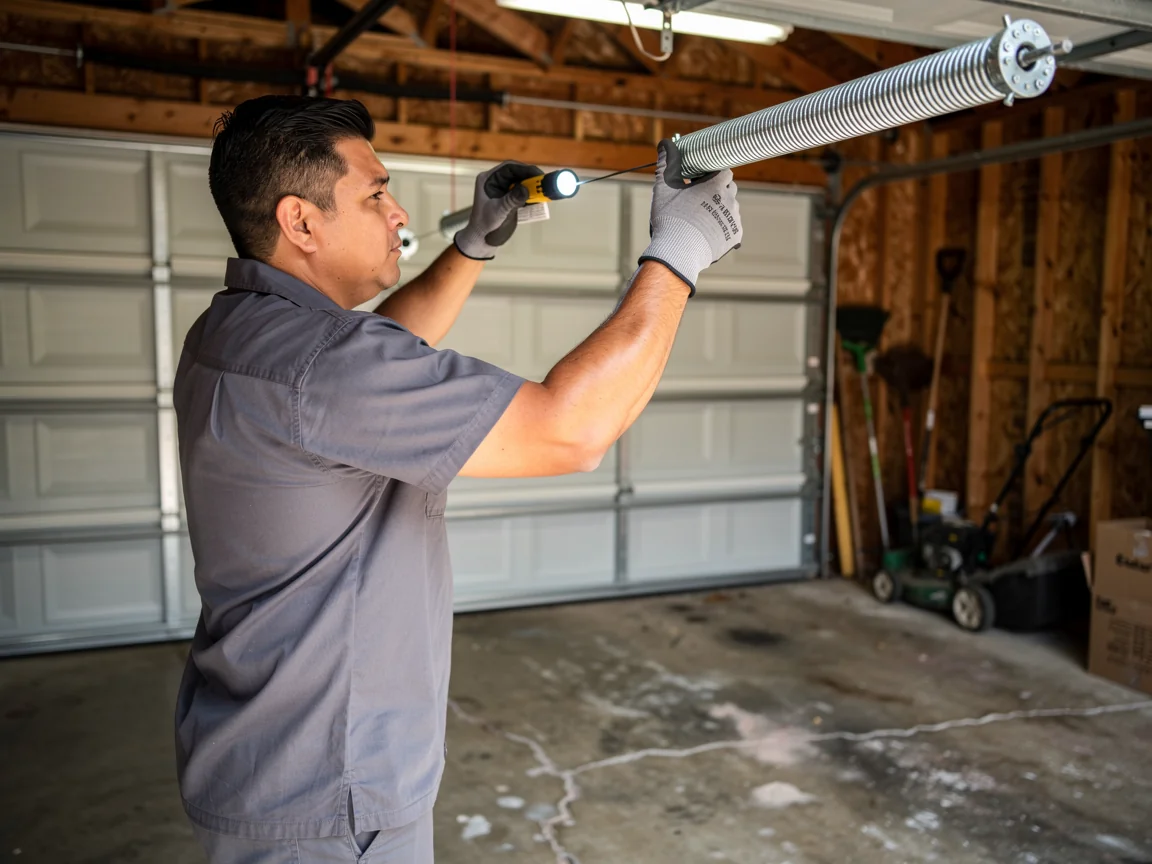
Most calls we get in Rowlett start the same way: a door that worked fine last week now hesitates, reverses, or won't budge. The trouble is that homeowners often try to diagnose it themselves and end up replacing the wrong part. A sagging door gets blamed on the opener when the real fault is a stretched cable or a spring that's lost half its tension. Because Rowlett's housing stock spans 1973 to 2013, with a median build year around 2003, you've got a wide mix of hardware out there - older torsion setups next to newer extension-spring systems - and the fix for one is wrong for the other. We see people buy a universal opener kit online, install it, and still have a door that drags on the track because nobody checked the rollers or the cable drum underneath. Diagnosing the actual failure point before touching anything is most of the job. The honest limitation here: if your springs are original to a house built in the early 2000s, we're not going to patch them. Twenty-plus years of cycling is past the point where a partial fix makes sense, and we'll tell you that instead of billing you twice.
What Causes It Around Here
Rowlett's heat band is moderate, not extreme, but it's steady - and steady heat cycling is what ages springs, lubricant, and rubber seals over the decades this housing stock has been standing. A door built in 1985 has been through roughly forty summers of expansion and contraction on the same torsion spring, and that kind of fatigue doesn't announce itself until the spring just lets go. Because so much of the area's housing, per Census figures, falls into that 1973-2013 window with a concentration of 2000s-era construction, a large share of doors are hitting the age where galvanized springs, nylon rollers, and OEM openers from that build era start failing within the same few years of each other. It's not one bad batch of hardware - it's thousands of houses aging on a similar clock. Add in that a lot of the original installs used economy-grade springs rated for the builder's price point, not for 15-20 years of Texas heat cycling, and you get the pattern we see on service calls: multiple components near end of life at once, not a single isolated break.
How We Fix It
We start by checking the spring tension, the cable condition, and the track alignment before we touch the opener - because in a house from this era, the opener is almost never the first thing to fail, just the first thing people notice. If the spring is original to a 1990s or early-2000s install, we replace it with hardware rated for the cycle count a moderate-heat climate actually puts on it, not the builder-grade spec it shipped with. Track alignment gets checked against the slab, since houses built over this 40-year span settle differently depending on the foundation work done at the time. For openers nearing the end of their service life, we match replacement units to the door weight and track type already in the house rather than defaulting to whatever's cheapest. We don't carry every obscure part for pre-1980s doors - if your garage still has its original hardware from that early end of the build range, parts lead time can run longer, and we'll tell you that up front rather than quote a same-day fix we can't deliver.
How It Shows Up
In Rowlett, the failure usually shows up as one of three things: a door that reverses partway up, a spring that snaps with a loud bang while the door is down, or an opener that runs but the door doesn't move - cable off the drum. Given the age spread in local housing, we're as likely to see a 2005-build house with a tired torsion spring as a 2012-build house with a failing circuit board in the opener. Across the broader service area, where median household income runs over $131,000 and most houses are owner-occupied rather than rented, we also see more homeowners catching the early warning signs - a louder-than-usual cycle, a slight shudder - and calling before the spring actually breaks, which is the cheaper call to make. If you're near the edges of our coverage toward Heath or Sunnyvale, the same build-era pattern holds; the housing stock doesn't change much from one side of the area to the other.
Frequently asked questions
How old does a garage door spring have to be before it should just be replaced, not repaired?
If the spring is original to a house built before the early 2000s, we replace rather than patch it. At that age the steel has gone through enough heat cycling that a partial repair just shifts the failure point a few months down the road instead of solving it.
Why does my opener from a 2000s-built house keep reversing?
Usually it's not the opener logic - it's a stretched cable or misaligned track telling the opener's safety sensor that something's wrong. We check cable and track condition before replacing any electronics, since swapping the opener alone often doesn't fix it.
Do you stock parts for older original hardware?
Not for every configuration. Doors from the early end of the local build range, mid-1970s to 1980s, sometimes use hardware we have to order in rather than keep on the truck. We'll tell you upfront if your job needs a part with a longer lead time.
Related services
Related guides
By Neighborhood
Garage Door Service across the Rowlett area
We also handle garage door service in these Rowlett-area suburbs.
Book garage door service in Rowlett
Call now or request a quote - tell us what the door is doing and where you are.